
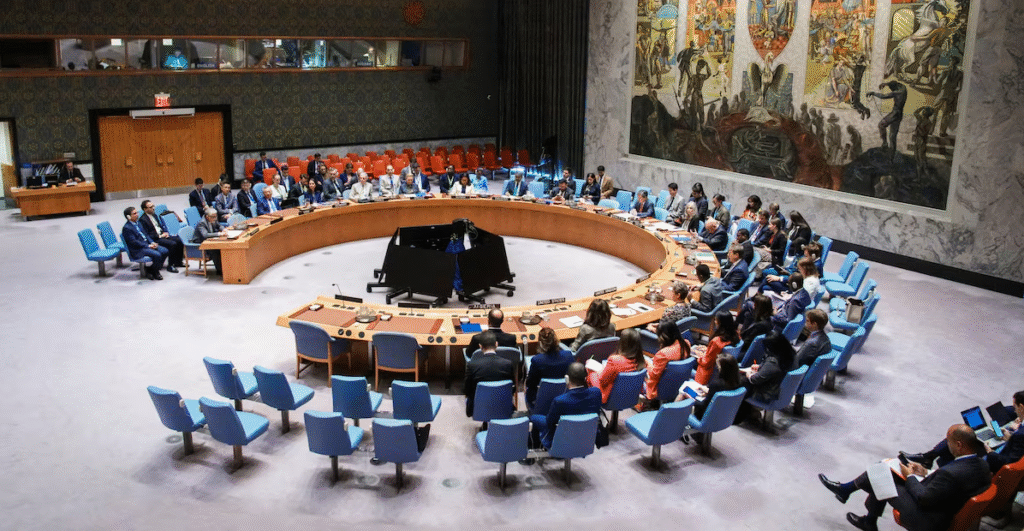
In a critical move for global diplomacy, the UN Security Council has once again rejected a final attempt to delay the reimposition of sanctions on Iran over its nuclear program. This decision comes just one day before the sanctions are set to take effect and follows weeks of tense negotiations that, according to Western powers, failed to yield a “concrete” agreement.
The Russia-China Resolution and its Fallout
On Friday, September 26, 2025, a resolution spearheaded by Russia and China—the closest and most powerful allies of Iran on the 15-member Security Council—failed to gather the nine votes necessary to prevent the snapback of UN sanctions. This move would see the return of sanctions originally lifted under the 2015 nuclear deal, which was signed between Iran and world powers.
The sanctions, if reinstated on Saturday, will freeze Iranian assets abroad, halt international arms deals, and penalize Tehran’s missile development program, further tightening the economic noose around the already struggling nation.
For Iran, the stakes are high. The return of sanctions comes at a time when its economy is reeling from multiple crises, including the long-term impact of previous sanctions. But what is more alarming is the risk of further escalating the already volatile tensions between Iran and Western nations.
Impact on Diplomatic Efforts and Iran’s Response
In the lead-up to this resolution, Iran’s Foreign Minister Abbas Araghchi has been in frequent talks with European counterparts—France, Britain, and Germany (the E3)—in a bid to avoid the sanctions. These negotiations, however, have yielded no tangible results. A European diplomat revealed to the Associated Press that discussions had “produced no new developments,” leaving the situation at a deadlock.
The failure of these talks has cast a shadow over any potential for diplomatic resolution before the deadline. Even remarks made by Iran’s Supreme Leader, Ayatollah Ali Khamenei, earlier this week—which described peace talks with the U.S. as a “sheer dead end”—have underscored Tehran’s unwillingness to compromise in the face of mounting pressure.
Localized Perspective:
From a regional perspective, the reimposition of sanctions is a double-edged sword. While the Iranian government continues to portray these sanctions as part of a broader Western conspiracy to undermine the country’s sovereignty, many ordinary Iranians fear the financial burden they will bear as the economy worsens. The already high inflation, devaluation of the rial, and scarcity of goods are likely to intensify. Meanwhile, hard-liners within Iran argue that any concession to the West would amount to weakness, complicating the government’s ability to balance diplomacy with domestic expectations.
The International Response: Growing Divide
The Security Council’s decision illustrates a deepening division between the West and countries like Russia and China, who have staunchly supported Iran’s right to continue its nuclear program. Russia’s deputy ambassador to the UN, Dmitry Polyanskiy, lamented the failure of the West to pursue a path of diplomacy. He criticized European and American approaches, claiming they only escalate tensions in the region through “blackmail” tactics.
From Moscow and Beijing’s perspective, prolonging the dialogue between Iran and the E3 could offer a diplomatic solution, though that now seems increasingly unlikely.
On the opposite side of the debate, the European powers, led by the E3 countries, have expressed that they are open to extending the deadline—provided Iran meets a series of strict conditions. These conditions include resuming negotiations with the United States on Iran’s nuclear program, granting UN nuclear inspectors unfettered access to Iranian nuclear sites, and addressing the concerns regarding the stockpile of uranium enriched to 60%—a level dangerously close to weapons-grade.
The Nuclear Threat: Global Implications
While the diplomatic deadlock continues, the risk of further nuclear proliferation looms large. Iran remains the only country in the world without nuclear weapons to enrich uranium to 60%, just short of the weapons-grade threshold.
Earlier this month, Iran signed an agreement with the UN’s nuclear watchdog, the IAEA, mediated by Egypt, to resume nuclear inspections. This agreement was viewed as a potential breakthrough, but Iran has threatened to terminate the deal and cut all cooperation if the sanctions are reimposed.
Iran’s wariness about giving inspectors full access stems from the aftermath of a 12-day conflict with Israel in June, which saw both Israeli and American forces targeting Iranian nuclear sites. This attack has raised questions about the integrity of Iran’s nuclear facilities and the exact state of its uranium stockpile.
Local Concerns and the Human Impact
On a local level, the people of Iran remain caught in the crossfire of this geopolitical struggle. Sanctions have already crippled the Iranian economy, and reimposing them will only deepen the country’s financial woes. For ordinary Iranians, the consequences are felt in every corner of daily life—from rising food prices to a deteriorating healthcare system.
Given these realities, the Iranian government’s position is increasingly one of defiance, but the question remains: How much longer can the country maintain this stance without further destabilizing the region?
Looking Ahead: What’s Next for Iran and the World?
The UN’s decision to reject Russia and China’s proposal sets the stage for heightened tensions between Iran and the West. As the sanctions are poised to take effect, all eyes will be on how Iran reacts. Past threats of withdrawing from the Nuclear Nonproliferation Treaty (NPT) are likely to reemerge, with comparisons to North Korea’s decision in 2003 to abandon the NPT and develop nuclear weapons.
In the coming weeks, there could be significant shifts in the diplomatic landscape, but as of now, the prospects for an immediate resolution remain dim. With Iran’s nuclear program edging ever closer to weapons-grade capability and Western sanctions tightening their grip, the global community is bracing for what comes next.