
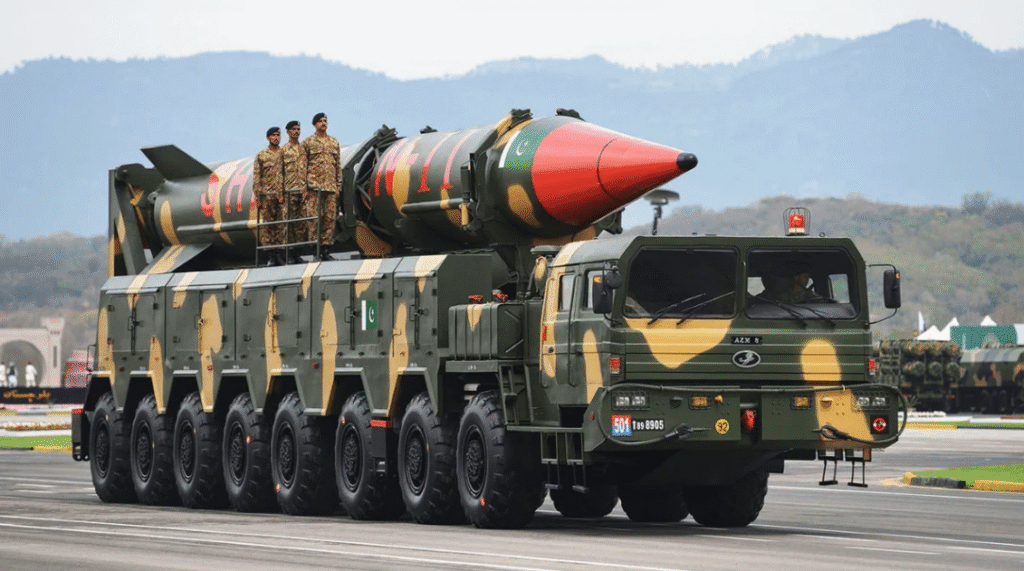
When U.S. President Donald Trump claimed last week that Pakistan — alongside Russia, China and North Korea — has been secretly conducting underground nuclear tests, it reignited one of the most enduring mysteries of South Asia’s security landscape: the opacity surrounding Pakistan’s nuclear weapons programme. In a CBS interview, Trump said several countries were “testing underground, where people don’t know exactly what’s happening,” suggesting that the United States might “follow suit.”
Pakistan rejected the suggestion as baseless. A senior Pakistani official said that Pakistan “was not the first to carry out nuclear tests and will not be the first to resume nuclear testing”. The statement underscored Pakistan’s continued adherence to its self-imposed moratorium on nuclear explosions, in place since its 1998 Chagai tests. Trump’s comment, however, had already set off a new round of speculation, fanning rumours that a recent series of small earthquakes in the Pakistan-Afghanista.
Between April 30 and May 12, 2025, at least four tremors between magnitudes 4.0 and 4.7 struck the area. These magnitudes were similar to Pakistan’s 1998 tests. At that time, experts refuted the nuclear-test rumours, pointing out that the region sits on one of the world’s most active fault lines. Trump’s latest statement has breathed new life into long-standing suspicions that Pakistan occasionally conducts hidden nuclear tests.
The puzzle of seismic signals and hidden tests
Pakistan’s only confirmed nuclear detonations occurred in May 1998, when six underground tests were carried out in the Ras Koh Hills and Kharan Desert, registering seismic magnitudes near 4.8. These events were easily detected worldwide by the Comprehensive Nuclear-Test-Ban Treaty (CTBT) monitoring network. Given today’s far more sensitive seismic and radioactivity detection systems, it is difficult to imagine that Pakistan—or an.
Nonetheless, whispers persist. The Afghanistan-Pakistan borderlands are geologically fragile, and earthquakes are frequent, but conspiracy theories linking tremors to secret tests have persisted for years. In May, some social media posts even claimed that Indian missiles struck Pakistan’s Kirana Hills, allegedly a nuclear storage facility, and that a U.S. “Nuclear Emergency Response” aircraft was seen over Pakistan on FlightRadar. None of these claims were corroborated by official sources. Analy.
What remains clear is that while small underground nuclear tests are technically feasible, there is no verifiable evidence of Pakistan having resumed them. The official global monitoring system has reported no anomalies consistent with nuclear explosions, and geological experts continue to attribute recent tremors to natural seismic activity.
Who really controls Pakistan’s nuclear arsenal?
Trump’s assertion that Pakistan might be independently conducting secret nuclear tests inevitably revives another deep question: who actually controls Pakistan’s nuclear weapons? Officially, Pakistan maintains that its arsenal is fully sovereign and managed through the National Command Authority, an institutional structure designed to ensure tight military oversight and prevent unauthorized use.
However, the narrative is complicated by claims, including a recent one from former CIA officer John Kiriakou, who alleged in an interview that during Pervez Musharraf’s presidency in the early 2000s, the Pentagon effectively took control of Pakistan’s nuclear weapons. Kiriakou claimed that Musharraf, facing U.S. pressure and fearing the weapons might fall into terrorist hands, informally handed over operational control to Washington. Islamabad has vehemently denied such assertions, insisting.
The controversy triggered by Trump’s words is less about what he revealed and more about what remains hidden. Since 1998, Pakistan’s nuclear program has operated behind a veil of strategic secrecy. Its testing history, command structure, and modernization plans all shrouded in uncertainty.