
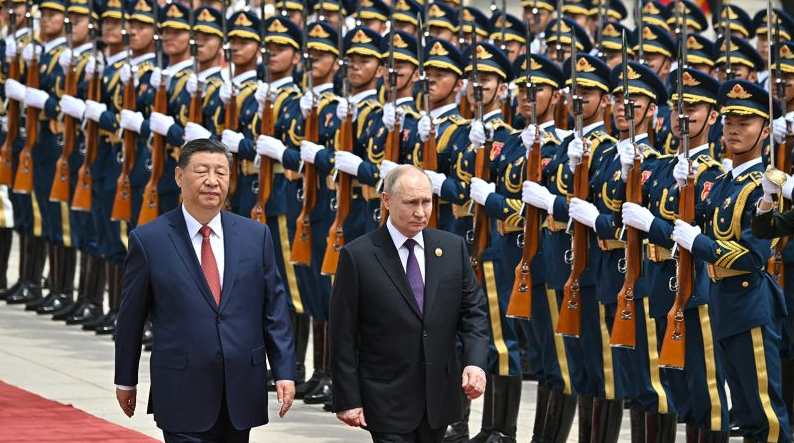
On Wednesday he will commandeer Beijing’s main artery – the Avenue of Eternal Peace – for a major military parade showing off the country’s cutting-edge hypersonic weapons, nuclear-capable missiles, and undersea drones, alongside thousands of goose-stepping soldiers.
Xi’s message with his multi-day exercise of soft and hard power, is clear: China is a force that wants to reset global rules – and it’s not afraid to challenge those of the West.
Hitting that message home is Xi’s guest list for the gathering, a cohort of more than two dozen China-friendly world leaders topped by Russian President Vladimir Putin and North Korean leader Kim Jong Un, which also includes Iranian President Masoud Pezeshkian.
That also makes the first time that the leaders of a quartet of nations Washington strategists warn are converging to form an anti-American “axis of upheaval” will be together in one event.
For the Western leaders desperately trying to ramp up pressure on Putin to end his war in Ukraine, those optics will appear stark.
Iran, North Korea, China and Russia are seen as an emerging anti-American axis by some observers in the West precisely because Tehran and Pyongyang have fed Moscow weapons and – in the case of Pyongyang – troops, while China has aided its war-torn economy and industry.
As Xi gives them seats by his side on a symbolic day for China, he is showing himself as the one global heavyweight who could stand a real chance to pressure Putin to end his war – and that he’s not going to use that pull to play by the West’s rules.
For Xi, China’s longest-serving and most powerful leader in decades, the symbolism – and its timing – will be purposeful.
These moments are arguably as powerful outcomes as the statements made, signaling a convergence of leaders without the West.
“What Xi is trying to convey is certainty about China’s role in international affairs. This is clearly signaling to people throughout the region that China has arrived as a great power and it’s not going anywhere,” said Jonathan Czin, the Michael H. Armacost Chair in Foreign Policy Studies at Brookings.
“If you’re a US ally or partner, sitting in a capital somewhere in the region, and you have real doubts about whether or not you can rely on the United States as a partner, that’s an uncomfortable split screen to be viewing,” he added.
‘The time is now’
Throughout his pageantry and diplomacy of recent days, Xi has appeared well aware of the opening the shake-up of American foreign policy has given him.
“(We must) oppose the cold war mentality, block confrontation and bullying practices,” Xi declared as he spoke to a room of gathered leaders Monday, using language that’s long been China’s code to describe what it sees as the US’ behavior. He also pledged hundreds of millions in grants to SCO member states this year – and launched a push to reform the international system.
The message is not new, but Beijing is betting it lands differently after the leading global superpower has cut off its vast network of foreign aid, slapped crippling tariffs on developing countries, and raised questions among its allies and partners about whether it really has their backs.
As China’s leader put it in a speech late Monday: “The house rules of a few countries should not be imposed upon others.” Look no further than India, whose Prime Minister Narendra Modi was seen smiling and laughing as he spoke with Xi beside Putin on Monday – a significant show of warmth from a leader long wooed by US as an Asian counterweight to China.
Just last month India was slapped with up 50% tariffs on its exports to the US, half of those due as a penalty for its purchases of Russian oil, which the US sees as helping to fund Putin’s war.
And even for countries, like those in Southeast Asia, who have long looked warily at China’s growing military power and assertiveness when it comes to its territorial claims in the South China Sea and over Taiwan, the shifting global dynamics could have an effect, observers say.
If there’s a time to woo leaders that have long tried to hedge between the US and China, said Chong Ja Ian, an associate professor at the National University of Singapore, “the time is now.”
‘A Credible Alternative’
But as much as Xi is using his highly choreographed itinerary this week to pitch his leadership to a broad cohort of nations, he’s also using it to push back on Western criticism of his longstanding ties with partners like North Korea, Russia and Iran – all seen as rogue actors by the West.
“(China’s military parade) will be the first time that the leaders of China, Russia, North Korea, and Iran are all present in the same place,” said Brian Hart, a fellow of the China Power Project at the Center for Strategic and International Studies (CSIS). “There have been little or no quadrilateral engagements between the four countries, so this is a distinctive moment.”
China has been careful to not be seen as explicitly endorsing these countries’ aggression – for example it’s widely seen to have sent large quantities of dual-use goods but not lethal weapons to Russia as it wages its war.
But as Xi gathers these players together, he wants to signal that he can set the rules around who “should be deemed acceptable by the international community, regardless of what the democratic West or the US may think,” according to Steve Tsang, director of the SOAS China Institute at the University of London.
Even still, the optics may also appear less stark with Trump in the White House. Last month, he hosted Putin for an apparently friendly summit where he said he’d “always had a fantastic relationship” with the warring leader and greeted him personally on the tarmac.
The American president also used a meeting with South Korean President Lee Jae Myung last month to discuss meeting again with Kim. Both would be peace efforts – but Trump is well known to praise these autocrats.
Like Putin, Xi has looked to pull from that history to reshape a narrative that positions China and Russia, which fought in World War II as the Soviet Union, as guardians of a “post-war” international order, distinct from the US-one they see as dominant now.