
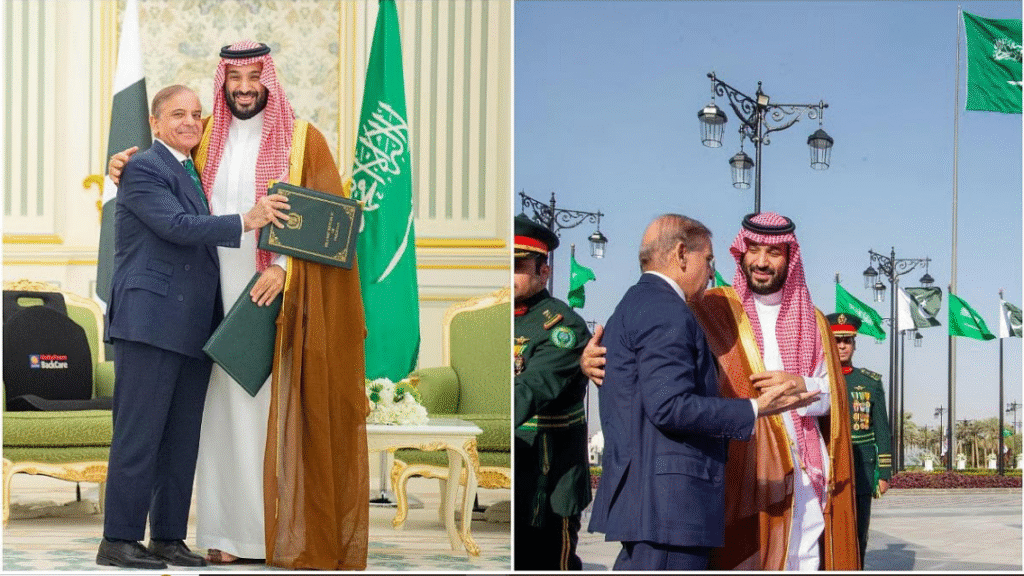
Saudi Arabia and Pakistan have solidified their alliance with a strategic mutual defense agreement, treating an attack on one as an attack on both. This pact, signed amidst regional tensions following an Israeli airstrike in Doha, signals a shift in Saudi Arabia’s reliance on US security guarantees.
For the first time, Israel must plan for a world in which its military actions could invoke a nuclear response-not from Iran, its longtime antagonist, but from a Sunni ally of Washington. TL; DR: Driving the newsSaudi Arabia and Pakistan have signed a sweeping strategic mutual defence agreement, declaring that an attack on either will be treated as an attack on both.The deal comes just days after Israel’s airstrike on Doha, which killed some senior Hamas leaders amid ceasefire talks – triggering outrage across Arab capitals.
Pakistan, a nuclear weapons state, is now officially linked to Saudi defence, reshaping strategic equations in the Gulf and South Asia.Saudi Crown Prince Mohammed bin Salman and Pakistan Prime Minister Shehbaz Sharif signed the pact in Riyadh. Pakistan’s army chief, Field Marshal Asim Munir, attended – signaling the military’s endorsement of the pact’s implications.Why it matters
- This pact upends the old US-centric security architecture in the Middle East and creates new risks and alliances across three regions.
- For Israel: The inclusion of Pakistan’s nuclear umbrella introduces a new deterrent against its regional military actions.
- For India: The pact emboldens Pakistan, adds uncertainty in future conflicts, and risks tilting Arab support away from India.
- For China: This is a quiet strategic windfall – an opportunity to deepen influence with two key allies while sidelining the US.
- For the US: Washington’s credibility as a security guarantor in the Gulf is now under serious question.
“This agreement… strengthens joint deterrence against any aggression,” said a joint statement from Saudi and Pakistani officials – seen as a direct response to Israel’s Qatar raid.Between the linesSaudi officials insist the pact is “not aimed at any specific country.” But regional analysts agree the timing isn’t accidental.The Doha strike was a turning point. It exposed Qatar – home to a major US military base – as vulnerable. Gulf states saw Washington’s silence as complicity.Saudi Arabia, already exploring alternatives to US guarantees, acted swiftly to make permanent its defence relationship with Pakistan – long speculated, now official.Crucially, the pact is deliberately ambiguous about whether Pakistan’s nuclear arsenal is included – a gray area that adds deterrent weight without triggering international red lines.“This is a comprehensive defensive agreement that encompasses all military means,” a senior Saudi official told Reuters.Is this the start of an Islamic or Arab Nato?
- The Saudi-Pakistan defence pact has reignited talk of a long-dreamed but elusive idea: a collective Muslim military alliance often called an Islamic or Arab Nato. For decades, this concept has surfaced in moments of crisis – and usually faded. This time, the conditions feel sharper.
- The symbolism is striking. Saudi Arabia – custodian of Islam’s holiest sites – has formally bound its security to Pakistan, the only Muslim-majority nuclear state. Qatar, directly attacked, may seek similar guarantees.
- Turkey, already in Nato, has long envisioned an Islamic bloc.
- The Gulf mood has shifted: reliance on US protection feels increasingly hollow after Washington failed to prevent missiles from striking Doha. As the SCMP noted, Arab states now see little choice but to take “real and tangible measures” themselves.
- Yet obstacles are formidable. Rivalries among Muslim states – Saudi Arabia versus Iran, Qatar versus the UAE, Turkey versus Egypt – make collective action fragile. The Economist observed that calls for an “Islamic Nato” often ring hollow given how many Arab regimes distrust Iran, one of the loudest voices pushing for such a bloc.
- Still, momentum is undeniable. The idea of Gulf and wider Muslim states pooling military resources against a common external threat has more traction now than at any point since the Arab Spring.
Zoom in: Israel’s new deterrence dilemmaWhile Saudi Arabia has in recent years pursued a cautious rapprochement with Israel, including back-channel talks and limited normalization, the latest developments may put such overtures on hold. The pact with Pakistan, a country with no diplomatic relations with Israel and a history of supporting Palestinian causes, sends a message that Riyadh is willing to hedge its bets and strengthen deterrence against perceived threats, even if it means aligning with states outside the Abraham Accords framework.For the first time, Israel must plan for a world in which its military actions could invoke a nuclear response-not from Iran, its longtime antagonist, but from an ally of US.Israel’s military freedom of action – especially cross-border strikes – just encountered a nuclear tripwire.Israel’s strike on Doha aimed to decapitate Hamas leadership but instead:
- Killed normalization prospects with Riyadh.
- Galvanized Islamic unity.
- Activated a defence pact with nuclear implications.
Now, any future Israeli strike in the Gulf risks:
- Provoking Pakistani retaliation, potentially conventional or cyber.
- Drawing condemnation from a unified bloc of Arab states.
- *Empowering Hamas and Hezbollah, who can claim new backing from a major Muslim coalition.
Expect Tel Aviv to:
- Accelerate defence upgrades (e.g., Iron Dome, Arrow-3, David’s Sling).
- Double down on ties with India and the US for strategic depth.
- Exercise greater caution before any unilateral action in third-party Gulf states.
Israeli analysts called the pact a “game-changer” and warned of an “expanded threat matrix.”Zoom in: India’s uneasy balancing act
We have seen reports of the signing of a strategic mutual Defence pact between Saudi Arabia and Pakistan. The Government was aware that this development, which formalises a long-standing arrangement between the two countries, had been under consideration. We will study the implications of this development for our national security as well as for regional and global stability. The Government remains committed to protecting India’s national interests and ensuring comprehensive national security in all domains.
MEA on Saudi Arabia-Pakistan defence pactIndia faces a sharp strategic squeeze. It has deep ties to both Saudi Arabia and Israel, and a long-standing conflict with Pakistan.The concern is less about direct Saudi involvement in a South Asian conflict and more about symbolism and support. Pakistan, emboldened by Riyadh’s backing, may adopt a harder stance in future crises-whether over Kashmir, terrorism, or water rights. If Saudi financial support flows into Pakistan’s defence modernization, India may find itself facing a better-equipped adversary.
This places India in an uncomfortable diplomatic position. It relies on Saudi Arabia as its third-largest oil supplier and a key investment partner. It also enjoys a deepening military relationship with Israel. The challenge now is to maintain both ties without appearing compromised or exposed.India’s likely response? Quiet hedging. Expect tighter defence cooperation with Israel, new military procurements, and back-channel diplomacy with Gulf states to ensure the pact doesn’t tilt against Indian interests.
- Diplomatic fallout: The MEA said it will “study the implications” of the pact for national security.
- Military calculus changes: With Pakistan now seen as having Arab backing, India fears a harder Pakistani posture in any future Kashmir crisis.
- Material concern: Saudi money could now strengthen Pakistan’s military, indirectly or directly – via oil subsidies, weapons upgrades, or tech transfers.
New Delhi’s likely response:
- Deepen defence ties with Israel (already India’s #2 arms supplier).
- Accelerate military modernization – especially missile systems and border defences.
- Step up diplomatic outreach in the Gulf to keep Riyadh neutral in South Asian crises.
Our relationship with India is more robust than it has ever been. We will continue to grow this relationship and seek to contribute to regional peace whichever way we can.
A Saudi official to AlJazeera
The US on the sidelines-or in the crossfire?The United States, once the unchallenged security guarantor of the Gulf, is watching from the margins. Its muted response to the Qatar strike and lack of visible deterrence has eroded confidence among allies.As Foreign Affairs noted earlier this year, “the US has become both too present and too absent-willing to support military campaigns, but unwilling to restrain them.”
The result? Gulf states are hedging. A mutual defence pact with a nuclear partner like Pakistan isn’t just about deterrence; it’s a declaration of independence from a security order many now see as broken.Washington now faces the unenviable task of holding together relationships with Israel, Saudi Arabia, India, and Pakistan-each of which sees the others with growing suspicion.China’s opportunity (and risk)China may be the quietest but biggest strategic winner here. It is already Pakistan’s closest partner (via CPEC) and has deepened ties with Riyadh through Belt and Road, energy deals, and arms sales.Beijing’s gains
- A stronger Gulf partner distancing from US influence.
- A rising role as regional arms supplier and mediator.
- Validation of China’s multipolar world strategy, with Washington increasingly sidelined.
China’s playbook:
- Publicly back the pact as defensive unity.
- Privately urge restraint – Beijing fears oil disruptions, instability, and escalation.
- As SCMP noted, “Beijing benefits from a realignment that validates its approach – diplomacy, deterrence, and development.”
What’s nextSeveral scenarios loom:
- US recalibration – Washington will likely attempt to rebuild trust with Saudi Arabia, possibly revisiting defence guarantees. At the same time, it may push Israel to avoid further unilateral escalations.
- Saudi balancing act – Riyadh will try to prove the pact doesn’t undermine ties with India, while strengthening its leadership role in the Muslim world.
- Pakistan’s rising profile – Expect more joint exercises, visible deployments, and louder rhetoric positioning Islamabad as protector of Muslim states.
- Potential domino effect – Qatar, Turkey, or even smaller Gulf states could seek similar arrangements, edging closer to a real “Arab Nato.”