The Disaster Management Centre (DMC) said more than 1.3 million people across the country had been affected by the record rains.
It is the worst natural disaster to hit Sri Lanka in two decades, and officials said the extent of damage in the worst-affected central region was only just being revealed as relief workers cleared roads blocked by fallen trees and mudslides.
The heavy rains that often sweep through the region at this time of year have been exacerbated by the rare formation of two tropical cyclones – Koto and Senyar – which have helped fuel the rains by bringing in more moist, warm air.
Indonesia’s meteorology agency said the formation of Senyar in the Strait of Malacca was a “rare” event, although one that had become more frequent in the past five years. “Indonesia’s location near the equator theoretically makes it less prone to the formation or passage of tropical cyclones,” said Andri Ramdhani at the Meteorology, Climatology, and Geophysics Agency (BMKG). Areas very close to the Equator usually lack the Coriolis force that enables storms to develop.
More broadly, the climate crisis has affected storm patterns, including the duration and intensity of the season, leading to heavier rainfall, flash flooding and stronger wind gusts.
The devastation in Sri Lanka was caused by cyclone Ditwah, which formed over the Bay of Bengal and made landfall on Wednesday, combining with the north-east monsoon season to bring disastrous rains.
Low-lying areas flooded over the weekend, prompting authorities to issue evacuation orders for those living along the banks of the Kelani River, which flows through Colombo into the Indian Ocean.
Thousands of police and military personnel are distributing food, clearing roads and moving trapped families to safety. Nearly 148,000 people have been displaced from their homes and are housed in temporary shelters.
President Anura Kumara Dissanayake, who declared a state of emergency to deal with the disaster, vowed to build back with international support. “We are facing the largest and most challenging natural disaster in our history,” he said in an address to the nation. “Certainly, we will build a better nation than what existed before.”
The rains have subsided across Sri Lanka but low-lying areas of the capital, Colombo, remained flooded on Sunday, sparking a major relief operation.
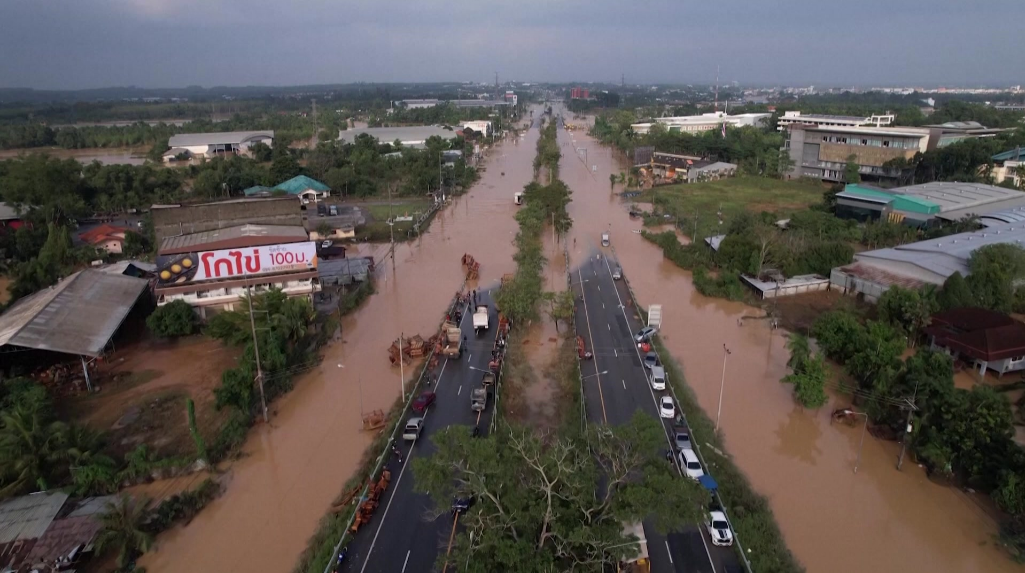
In Thailand, the ministry of public health reported the death toll from flooding in southern Thailand at 170 on Sunday, following some of the worst flooding in a decade.
Songkhla Province had the highest number of fatalities at 131. Hat Yai, the largest city in Songkhla, received 372mm (14.6in) of rain on 21 November, its highest single-day tally in 300 years, amid days of heavy downpours.