
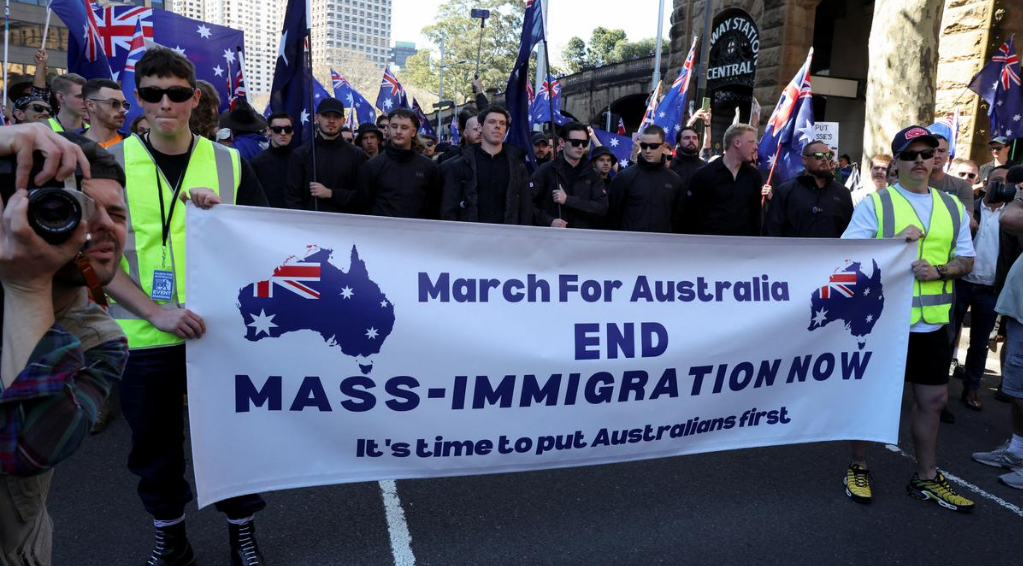
MELBOURNE: Over the weekend, rallies were staged across various Australian cities under the branding ‘March for Australia’. The rallies, which were attended by avowed neo-Nazis and elected politicians alike, called for an end to mass migration. These protests are not unique to Australia. Recently, the United Kingdom has seen its own wave of anti-migrant demonstrations in cities such as London, Bristol and Birmingham.
Despite claims by some that the Australian rallies were hijacked by the neo-Nazi National Socialist Network (NSN), they were deeply rooted in the far-right, white nationalist ideas of remigration and the Great Replacement theory.
An ABC investigation in the lead-up to the rallies found that remigration was listed on the organisers’ website as a key reason for marching, before later being deleted.
Significantly, the March for Australia rallies also received high-profile, online support from far-right figures overseas, including Alex Jones, Tommy Robinson, Jack Posobiec and Elon Musk.
For the rally organisers, public support from figures such as these greatly expands the reach of their message and repositions them from isolated fringe events to vital parts of a global anti-immigration movement.
This is not the first time Musk has inserted himself in the domestic politics of a foreign country to bolster the far right.
The tech billionaire notably gave his support to Germany’s far-right Alternative for Germany party in recent elections, describing it as the best hope for the country.
In recent days, he also posted the phrase remigration is the only way in response to a post about foreigners in the UK.
Remigration refers to the mass deportation of non-white immigrants to their so-called countries of origin.
It is an ideological cornerstone of ‘identitarianism’, a European far-right movement centred on preserving white European identities.
These are perceived to be under attack by immigration, globalisation and multiculturalism. Global growth of the far right. This online support for March for Australia underscores the growing transnational links among far-right movements.
And this transnational growth wouldn’t be possible without the proliferation of social media in recent years.
In Australia, for example, research shows how indispensable mainstream social media platforms have been in the development of anti-Islamic far-right movements such as the United Patriots Front, going back to the 2010s.
The far right also capitalises on virality and humour to extend the dissemination of their ideology online.
In particular, this is done through memes.
Research has found, for example, that one particularly prominent transnational far-right meme, Pepe the Frog, has been localised for an Australian audience through the addition of a Ned Kelly mask.
The online space makes it easier for extreme views and rhetoric to permeate mainstream political discourse, as well.
When elements of the far right get removed from mainstream social media platforms, a process known as deplatforming, they often find a new home on alternative platforms such as Telegram.
Research shows they now host a range of Australian neo-Nazi groups.
It’s noteworthy that many of the key figures lending support for March for Australia, including Robinson and Jones, were previously deplatformed from Twitter before Musk acquired the company and reinstated them.
Social media has also allowed neo-Nazis such as Tom Sewell, who is essentially persona non grata in Australian mainstream media, to build a large and highly influential profile among international far-right audiences.
With Musk’s vows to defend free speech on X, and Mark Zuckerberg’s dramatic shift in Meta’s approach to content moderation, the mainstream social media environment is becoming even more hospitable to far-right movements.
This is a worrying trend.
For the Australian far right, the support of figures such as Musk and Robinson signals an opportunity to increase their mobilising potential.
It could also lead to the transnational exchange of information, resources and tactical support.
As the far right becomes increasingly emboldened, mainstreamed and normalised, we should expect to see more public and increasingly violent demonstrations across Australian cities and support for these among a global audience online.