Shaun
Shaun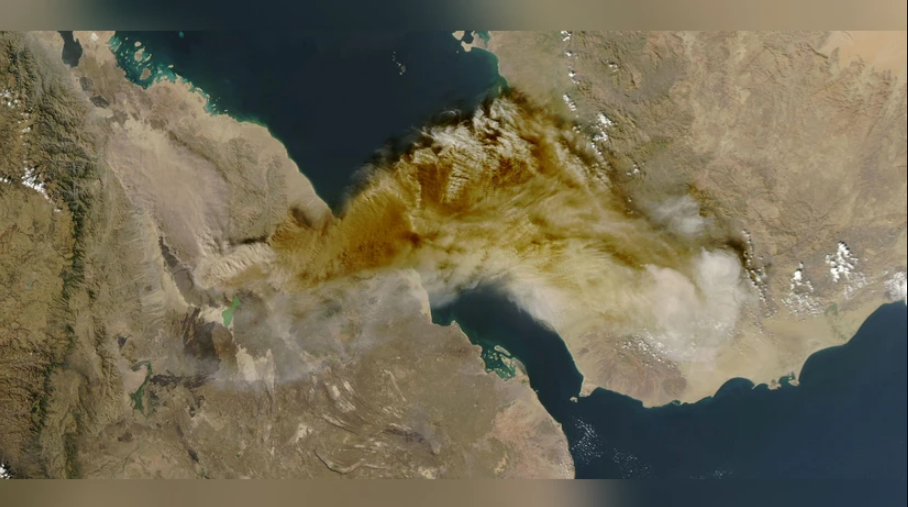
Hayli Gubbi volcanic eruption in Ethiopia: A high-altitude cloud of volcanic ash from Ethiopia which had entered the Indian region on Monday afternoon is expected to fully cross over to China by Tuesday evening. The volcanic ash emerged from a rare eruption of the Hayli Gubbi volcano in northeastern part of Ethiopia, near the Red Sea coastline, on Sunday.
The volcanic ash was travelling at a height at which most of the long-distance airplanes fly. These pose dangers of lack of visibility and possible inhalation of toxic gases like SO2. Airline schedules had to be disrupted to avoid these. The India Meteorological Department said the situation would revert to normal from Tuesday evening.
What was it?
The Hayli Gubbi volcano in northeastern Ethiopia erupted on Sunday, by all accounts for the first time in about 12,000 years. There was no lava or magma flow, but large amounts of gas and plume, consisting possibly of small fragments of rocks, glass and some other material, were ejected in an explosive eruption. The heavier among these would have fallen in nearby areas, but the very fine particles, and gases like sulphur dioxide or carbon dioxide, could rise very high in the atmosphere, about 15-40 km above the surface.
This happens mainly because the air around the volcano gets heated up severely, becomes lighter and rises up, taking along with it the finer particles and gases.
Following air currents, the volcanic ash and gases travelled westwards towards the Indian region, entering from Gujarat and Rajasthan, and then moving towards Delhi and Uttar Pradesh, in the southwest to northeasterly direction. Following the same trajectory, these are expected to move completely into China by Tuesday evening.
Was it dangerous?
The material coming out of volcanic eruptions are a major health hazard. But this plume was moving at very high altitudes because of which there was no threat to human beings. But they did pose a risk to airplanes, which mostly travel at these heights. Commercial airlines, mainly on long-distance international routes, usually fly between 10-14 km above the Earth, roughly in the zone in which the volcanic plume was moving.
The danger is mainly to the engines and other machinery of the airplane, because of which airlines avoid areas where volcanic eruptions are travelling. There is an international network of centres that track volcanic eruptions all over the world and issue alerts of possible risks. There are communicated to civil aviation authorities in real time, based on which air traffic is managed.
How does it end?
The movement of volcanic plume is a short-term phenomenon. Their impact would most likely cease to exist completely within the next couple of days. Over time, the fine particles in the plume get dispersed, and spread out in concentrations that are not a concern anymore. Clouds and rains wash out a lot of these, significantly mitigating their effects.
The gases in the plume, like sulphur dioxide or carbon dioxide, can remain much longer, but these gases already exist in the atmosphere. The amounts of these gases in the plume are not so high as to make any appreciable difference to their existing concentration in the atmosphere.


 admin
admin