Shaun
Shaun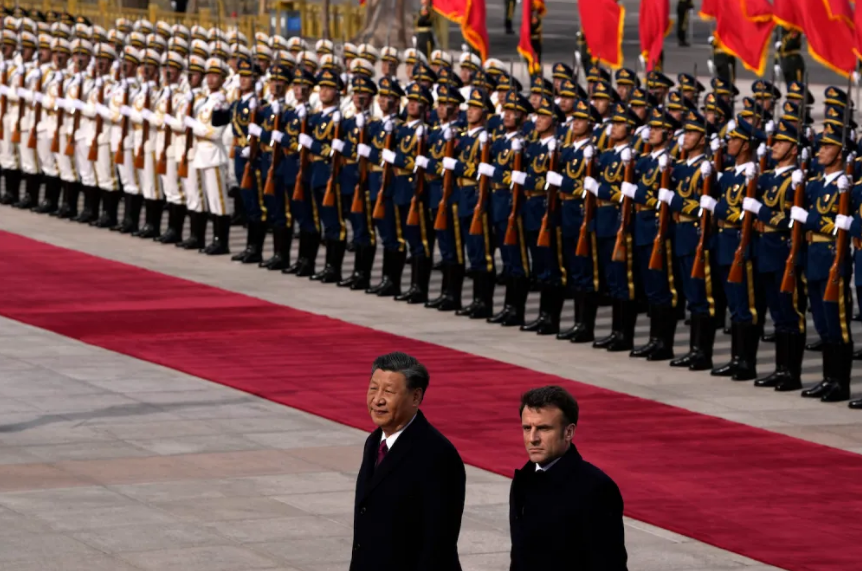
This week, Russian President Vladimir Putin had a clear message for Ukraine and its European allies: Moscow can keep going, because we have powerful friends.
The Russian leader stood shoulder to shoulder at various events in China with the men who have enabled him to wage his war on Ukraine for as long and as ferociously as he has: China’s leader Xi Jinping, Indian Prime Minister Narendra Modi, Iranian President Masoud Pezeshkian and North Korea’s Kim Jong Un.
More than three years into what Putin once thought would be a quick takeover of his much smaller and weaker neighbor, Russia would be unable to sustain the fight without Chinese and Indian money, Iranian weapons and, to a lesser extent, manpower from North Korea.
But the messaging from both the summit and military parade hosted by China this week went well beyond the war in Ukraine.
The leaders who gathered in China may not agree on everything. Some of them may not even like each other very much. But they are seeing the opportunity of a lifetime to end Western dominance of the global stage. And Europe fears it could be in the firing line.
The events provided a stark visual reminder of why Europe must rethink its security. It has spent recent years trying to isolate Russia’s leader and starve its economy, while also coming to terms with the fact that the United States may no longer be the ally it can always turn to.
“Russia is trying to demonstrate that even though it has been isolated from the Western world, it still has partners and allies which are economically strong countries… And this isolation doesn‘t mean that the Russian economy will crumble or that Russia will be unable to sustain its war effort,” Natia Seskuria, an associate fellow at the Royal United Services Institute (RUSI), told CNN.
The international order that was set after the end of the Cold War is clearly at risk of unraveling.
The US has been retreating from the global stage under President Donald Trump and his “America First” agenda. Meanwhile, Europe is battling its own demons, including a surge in far-right nationalism and economic pressures.
This week has laid these ambitions bare for everyone, including Trump, to see.
Trump did get the message. “Please give my warmest regards to Vladimir Putin, and Kim Jong Un, as you conspire against The United States of America,” he wrote in a message to Xi.
Strings attached
Despite all the recent hand holding and smiles, China’s and India’s approach to Russia’s war in Ukraine is dominated by pragmatism, analysts say.
China and India were more than happy to step in when Ukraine’s Western allies slapped sanctions on Russian oil, a key moneymaker for Moscow.
They get cheaper energy supplies as a result, but experts say the relationship is not just about the money.
While neither China nor India is willing to enter into a direct confrontation with the West, both are happy to see Russia pushing an anti-Western agenda.
Lough said Russia’s push against the US-dominated world order also plays well into the Indian narrative. “I think the Indians are not unhappy to see Russia pushing this agenda of fighting the corner of the Global South and ensuring that the system of global governance is adapted to accommodate the rising economies with large populations,” he told CNN.
Beijing and Delhi are now the world’s two largest buyers of Russian oil and coal, with China also being the second-biggest buyer of Russia’s gas and oil products.
The support goes beyond just oil. According to the US Treasury, both Chinese and Indian companies have been supplying Russia with so-called dual-use technologies, or components that can be used for both civilian and military purposes, such as chips or telecommunication equipment that Russia cannot get elsewhere because of Western sanctions.
“You only have to look at the number of Chinese components in the Russian drones that are landing in Ukraine to see that China is really a very important supplier,” Lough added.
Meanwhile, Ukraine and its European allies are not willing to dismiss India and China completely, because they are aware that, if anyone can put real pressure on Putin to end the war – in the absence of tougher action from Trump – it is likely Beijing and, perhaps to a lesser extent, New Delhi.
North Korea and Iran, meanwhile, have stood firmly on Russia’s side. Already sanctioned and isolated by the West over their nuclear programs and other activities, they have little to lose.


 admin
admin